
AI Readiness for People
How ready are you to work alongside AI and agents? Most AI skills checks ask you to rate yourself. This one also asks what you would do in realistic situations, shows you the gap between the two, and gives you a 90-day skills plan for your role.
Not just what you think. What you would do.
Your organisation can be ready for AI while its people are not. This scan measures the people side.
Pick the role closest to yours: executive or senior leader, people manager, knowledge worker, builder or technical specialist, or frontline and operations. Each role weights the six skills differently. Then rate yourself on each skill and work through 12 short, realistic work scenarios, choosing what you would actually do.
Scenarios count for two-thirds of each skill score, because what you would do says more than what you think. Your report shows your stage, where your self-rating and your choices disagree, the risky habits to fix first, and a 30/60/90-day plan of free learning for your role and level.
The Six Skills
Each skill has one self-rating and two scenarios.
AI Fluency & Mindset
Knowing what AI can and cannot do, and the curiosity to try it on real work.
Prompting & Context
Giving AI clear instructions, the right context and examples, and refining the result.
Critical Evaluation
Checking AI output, spotting errors and bias, and knowing when not to trust it.
Delegation & Agent Supervision
Breaking work into steps, briefing AI agents, and reviewing and approving what they do.
Workflow Redesign
Finding where AI fits in your own work, redesigning the task and measuring the gain.
Responsible & Secure Use
Protecting personal and confidential data, following policy, and spotting manipulation.
Five Stages, from Observer to Agent Boss
Your score out of 100 places you on one of five stages.
Observer (0–20)
You have tried little or no AI at work, or you avoid it. The first step is small, safe experiments on real tasks.
Experimenter (21–40)
You use AI now and then for one-off tasks, with mixed results, and you are not always sure when to trust it.
Practitioner (41–60)
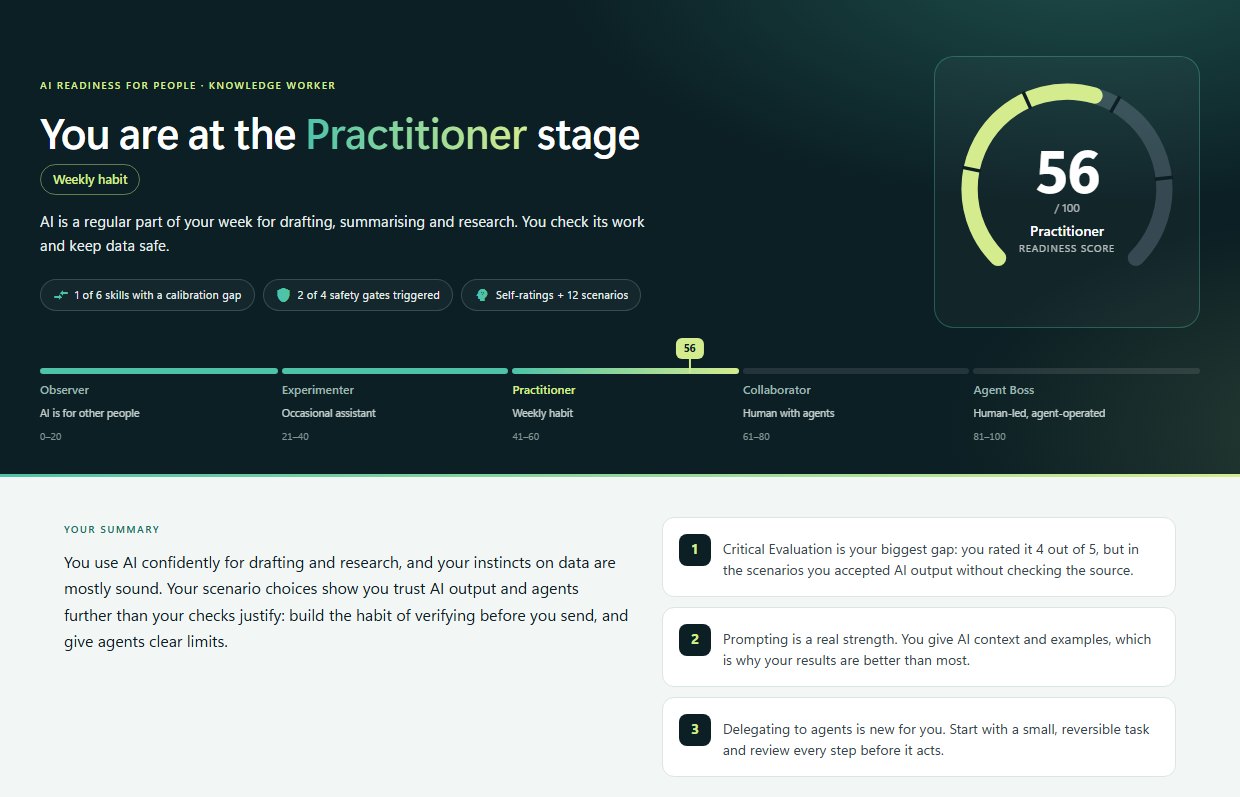
AI is a regular part of your week for drafting, summarising and research. You check its work and keep data safe.
Collaborator (61–80)
You redesign tasks around AI, brief agents clearly and review their work systematically.
Agent Boss (81–100)
You direct agents on whole pieces of work, set guardrails and checkpoints, and help others work this way.
What You Think vs What You Showed
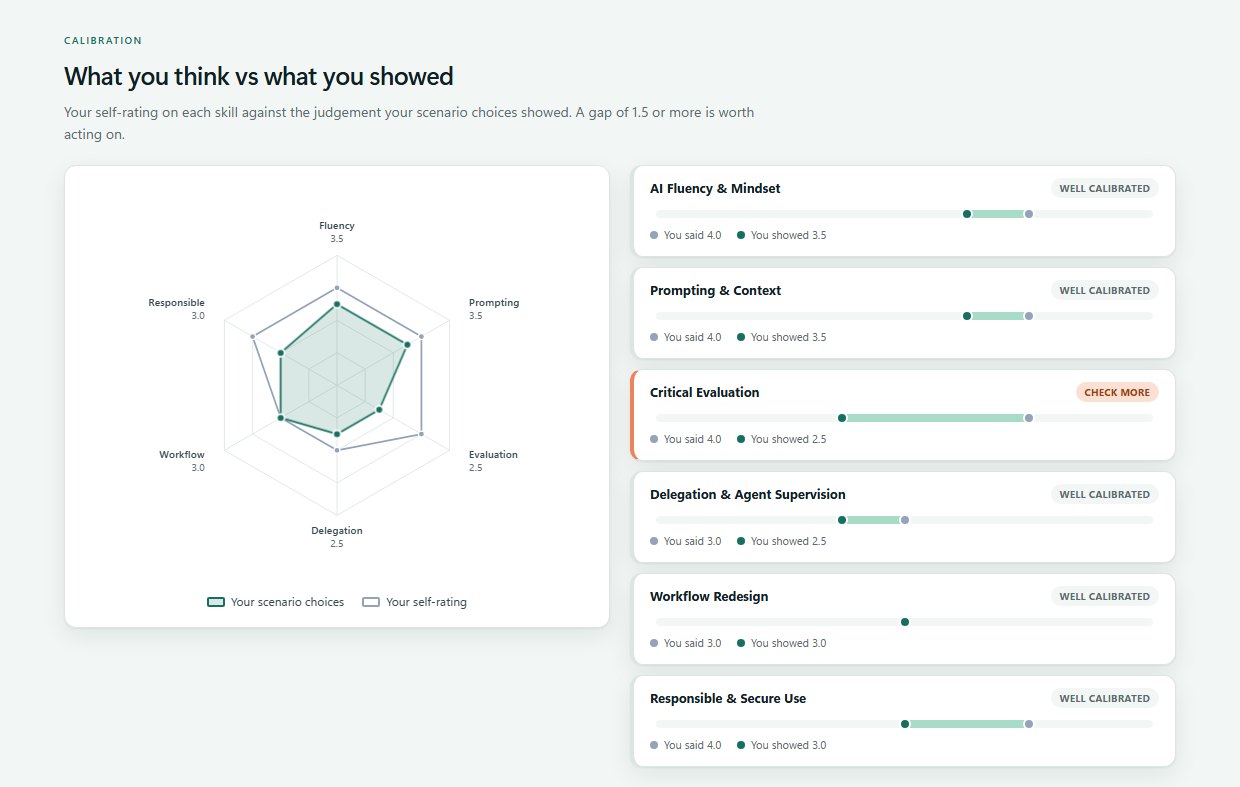
Calibration compares your self-rating with your scenario choices, skill by skill.
What You'll Receive
Add your name and email to get your score and plan. Job title and organisation are optional.
Score & Stage
Your readiness score out of 100 and your stage, with a six-skill profile.
Calibration
Your self-rating against your scenario choices, skill by skill. A gap of 1.5 or more is worth acting on.
Safety Gates
Four risky habits: sharing personal data with unapproved AI, relying on output without checking, acting on requests from untrusted content, and delegating to agents without guardrails.
90-Day Skills Plan
A 30/60/90-day plan of free learning matched to your role and level, mostly from Microsoft Learn.
PDF Report
Your report as a PDF, emailed to you and kept at a private link for 90 days.
Yours Alone
Your individual result is shared only with you, even when you take the scan with a team code.
Team Scans for Organisations
See where AI skills cluster across a team, anonymously, and where one workshop would lift everyone at once.
How a Team Scan Works
We set up your team
TTD creates the team and gives you two links: an invite for everyone taking part, and a private report link for the sponsor only.
Your people take the scan
Each person takes the same 9-minute scan through the invite link and gets their own private report.
The report opens at 5
The team report opens once at least 5 people have finished, so no one can be identified from the results.
Plan the programme
The sponsor sees the team’s stages, skill gaps, risky habits and a 30/60/90-day team plan.
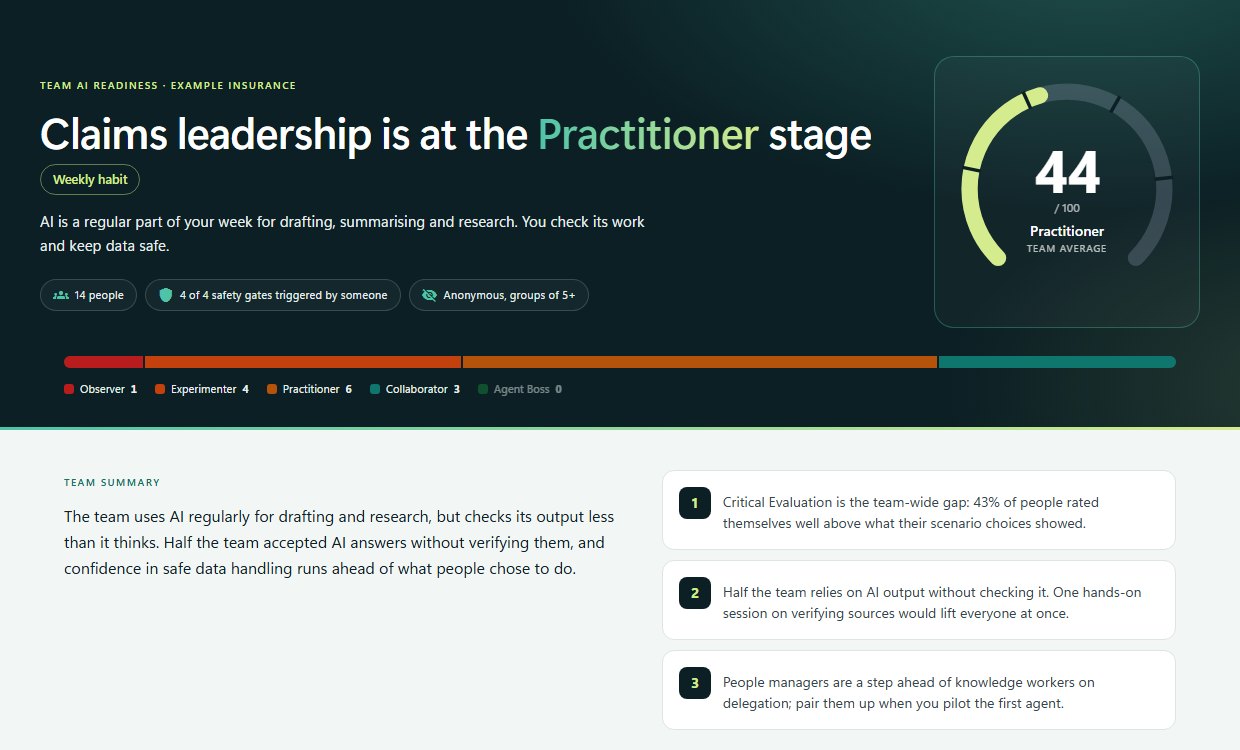
An example team report. Every figure covers at least 5 people.
What the team report shows
- The team’s average stage and how people spread across the stages
- What the team thinks versus what it showed, with skills flagged where a quarter or more of the team over-rate themselves
- Where skills cluster by role, for role groups of 5 or more
- Risky habits across the team, with the most common ones in the first 30 days
- The team’s 30/60/90-day plan
Anonymous by design
- Individual results never leave the platform: the organisation only ever sees totals
- Every figure in the team report covers at least 5 people
- People who retake the scan count once, with their latest result
- The sponsor’s report link is separate from the invite link and kept private
Frequently Asked Questions
How Ready Are You to Work With AI?
Find out in about nine minutes, and leave with a free 90-day skills plan for your role. Want the picture for a whole team? We will set up an anonymous team scan and help you plan the workshop.
~9 Minutes
12 Scenarios
90-Day Plan
Completely Free